PM-KUSUM Yojana Explained: How Farmers Can Earn Income from Solar Power
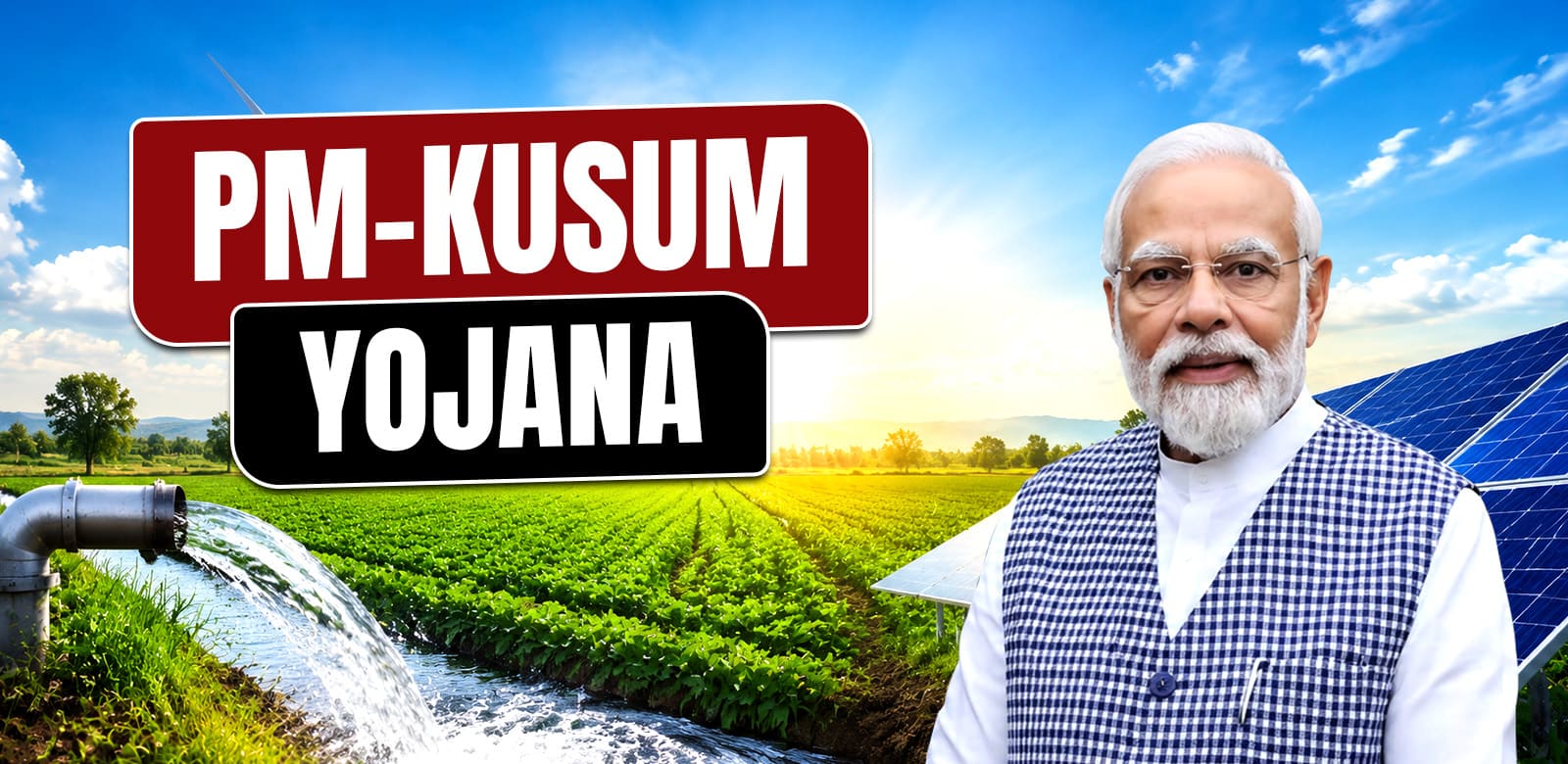
The PM-KUSUM Yojana (Pradhan Mantri Kisan Urja Surakshaevam Utthaan Mahabhiyan) is a national initiative introduced by the Ministry of New and Renewable Energy (MNRE) in 2019 to bring solar energy into Indian agriculture. The scheme focuses on lowering irrigation costs, reducing diesel usage and carbon footprints while creating long-term income opportunities for farmers through solar power generation.
By enabling the installation of solar pumps and decentralised solar plants, It empowers farmers to manage their own energy needs efficiently while also supporting India’s transition to renewable energy. Read on to understand how the PM-KUSUM scheme is designed to offer financial support to farmers and its relevance for the agricultural sector.
Major Components of PM-KUSUM Yojana
The objective of PM-KUSUM Yojana can be achieved through these three key components. Let’s breakdown them below:
Component A: Decentralised Grid-Connected Solar Power Plants
Under this component, small solar power plants with a capacity of up to 2 MW can be set up on barren, fallow, or even cultivable lands. If installed on cultivated land, solar panels are mounted at a height that allows crops to continue growing underneath. These plants can be set up by farmers, cooperatives, panchayats, or Farmer Producer Organisations (FPOs). Farmers also have the option to lease their land to a developer for setting up the plant.
The electricity generated is purchased by local distribution companies (DISCOMs) at tariffs set by State Electricity Regulatory Commissions. This component provides farmers and landowners with a stable long-term income, with loans and financing options available through banks or developers to cover installation costs. Since these are the decentralised power plants and are situated near consumers, It ensures a reliable supply of daytime electricity. Moreover, the solar power they generate enables DISCOMs to meet their Renewable Energy Purchase Obligation (RPO) targets, promoting wider adoption of clean energy in the region.
Component B: Standalone Solar-Powered Cultivation Pumps
It focuses on replacing diesel-powered irrigation pumps with solar-powered pumps, particularly in off-grid areas. Around 20 lakh farmers are expected to benefit while reducing both pollution and irrigation costs of approx Rs.50,000 per year (for 5HP pump). It will help in increasing the farmer’s income and living conditions. Financial support includes subsidies from both central and state governments with bank financing, so farmers typically need to pay only a small portion upfront.
This component also extends support to farmer groups such as Water User Associations and community or cluster-based irrigation systems, with priority given to small and marginal farmers. To encourage efficient use of water, preference is accorded to farmers who use micro-irrigation systems or are covered under existing micro-irrigation schemes. The capacity of the solar pump is determined based on local factors such as groundwater depth, irrigated land area, and actual water requirements.
Criteria Used to Determine Financial Support under Component B of PM-KUSUM Scheme
| Parameter | How It Is Determined |
|---|---|
| Eligible Beneficiaries | Individual farmers, Water User Associations, and community or cluster-based irrigation systems |
| Priority Category | Small and marginal farmers are given preference |
| Preferred Irrigation Method | Farmers using micro-irrigation systems or covered under micro-irrigation schemes |
| Maximum Pump Capacity | Subsidy applicable up to 7.5 HP worth approx 17.50 lakh (CFA applies up to 7.5 HP only; higher-capacity pumps allowed without additional subsidy) |
| Central Financial Assistance (CFA) | Up to 30% of benchmark cost (fixed annually by MNRE) |
| State Government Subsidy | Up to 30% of benchmark cost |
| Farmer’s Share | 40% of total cost |
| Bank Financing Option | Up to 30% of farmer’s share can be financed through banks |
| Initial Farmer Contribution | Approximately 10% of total system cost |
| Special Category States | Higher CFA up to 50% for NE States, hilly states, and island territories |
All solar pumps installed under this component are equipped with remote monitoring systems, enabling real-time tracking of their performance and operation. Approved vendors are required to provide repair and maintenance services for five years from the date the solar pump is commissioned. To ensure timely support, vendors must operate at least one authorised service centre in each implementation district and maintain a local-language helpline in every participating state.
Component C: Solarisation of Grid-Connected Agriculture Pumps
It focuses on the solarisation of grid-connected agricultural pumps to ensure reliable daytime power supply to farmers while promoting efficient water use and additional income generation. The component is implemented through two approaches:
- Individual Pump Solarization (IPS)
- Feeder Level Solarization (FLS)
Under IPS, farmers are allowed to install solar PV capacity of up to two times the pump capacity (in kW). It enables them to meet irrigation requirements through solar energy and sell surplus power to DISCOMs, thereby earning extra income. Under FLS, States are supported in solarising agricultural or mixed feeders, ensuring stable and clean power supply at the feeder level. The overall objective is to reduce dependence on conventional power, incentivize water conservation, and improve farmers’ financial sustainability.
The implementation of Component C is carried out by DISCOMs, or any other department designated by the State Government. These agencies submit project proposals to the Ministry of New and Renewable Energy (MNRE) for approval and receive applicable service charges as per the scheme guidelines.
Documents Required for KUSUM Application
- Aadhaar Card (mandatory)
- Land ownership documents
- Bank account details (passbook copy)
- Passport size photographs
- Existing electricity bill (for Component C)
- Water source certificate/proof
- Caste certificate (for SC/ST additional benefits)
- Income certificate (if applicable)
- Mobile number linked with Aadhaar
Eligibility for the PM-KUSUM Yojana
The following categories are eligible to apply under the KUSUM Scheme:
- Individual farmers
- Groups of farmers
- Farmer Producer Organizations (FPOs)
- Panchayats
- Cooperatives
- Water User Associations
How to Apply for the PM KUSUM Scheme
Here is the step-by-step procedure to submit your application and avail the benefits of the PM-KUSUM Yojana:
- Step 1: Visit the official KUSUM portal and click on the registration section.
- Step 2: Complete the registration form with all required details including personal, land, and pump-related details.
- Step 3: Read the declaration, check the box to confirm, and click Submit.
- Step 4: After successful registration, click on Log In for the Solar Agricultural Pumpset Subsidy Scheme 2021.
- Step 5: Fill out the online application form accurately, attach all necessary supporting documents, and submit the application.
Note: Once the online application is successfully submitted, farmers are required to deposit 10% of the total cost of the solar pump to the supplier as instructed by the department. The solar pump will be activated after the subsidy is sanctioned, which typically takes 90 to 120 days.
Top Benefits for Farmers under PM-KUSUM Yojana
1. Financial Savings and Additional Income
PM-KUSUM significantly reduces the financial burden on farmers by lowering their dependence on costly grid electricity and diesel-powered pumps. Solar pumps operate using free solar energy which results in long-term savings on fuel and electricity bills.
Beyond savings, farmers can earn additional income by selling surplus solar power back to the grid where grid connectivity is available. This creates a steady, predictable revenue stream, improving cash flow and strengthening overall financial security—especially during non-irrigation periods.
2. Energy Reliability and Self-sufficiency
Unreliable power supply and long outages often disrupt irrigation schedules. Solar-powered systems provide farmers with daytime power availability, ensuring timely irrigation without waiting for grid supply. Reliable and predictable daytime power allows farmers to plan irrigation schedules in advance rather than reacting to irregular grid supply. With assured water availability, farmers can choose crops based on seasonal water needs, schedule sowing and harvesting more accurately. It ensures timely irrigation at critical growth stages—resulting in healthier crops, better yields, and reduced risk of crop failure.
3. Environmental and Resource Sustainability
Adopting solar energy under PM-KUSUM directly cuts carbon emissions by replacing diesel and coal-based electricity with clean solar power. Agriculture in India traditionally relies heavily on diesel pumps and grid electricity generated largely from coal-fired power plants, which contribute significantly to greenhouse gas emissions. By switching to solar pumps, emissions from burning diesel and from coal-based power generation are avoided, helping reduce the sector’s carbon footprint. For example, solar irrigation under PM-KUSUM has already reduced CO₂ emissions by measurable amounts, contributing to national climate objectives.
This shift aligns with India’s broader renewable energy commitments. The Government of India has set ambitious targets to achieve 50 % of cumulative electricity capacity from non-fossil fuel sources by 2030 and to reach net-zero carbon emissions by 2070, as part of its international climate pledges. Increasing the share of renewable energy in all sectors, including agriculture, is essential to meeting these goals and reducing the country’s overall greenhouse gas emissions.
4. Employment Generation and Rural Development
The implementation of PM-KUSUM leads to employment generation at multiple stages of the project lifecycle—ranging from manufacturing, site surveying, installation, and grid connectivity to long-term operation and maintenance of solar plants and pumps. Since these activities must be carried out locally, they create direct job opportunities within rural areas which reduces dependence on seasonal farm income.
In addition, the scheme promotes skill development among rural youth, who are trained as technicians, electricians, and service providers for solar equipment. This builds a local workforce capable of maintaining renewable energy infrastructure. It encourages self-employment and small enterprises such as solar service and maintenance businesses. Over time, this diversification of income sources strengthens the rural economy and reduces over-reliance on agriculture alone.
5. Efficient Water Use through Modern Irrigation Practices
Solar pumps become even more environmentally valuable when combined with efficient irrigation methods such as drip (delivers water directly to the roots of plants) and sprinkler (evenly spray water over the fields) systems. It minimizes wastage and reduces the total energy and water required for irrigation. Efficient water use is especially important in many parts of India, where groundwater levels are declining. By pairing solar pumps with these smart irrigation techniques, farmers can conserve water, lower energy costs, and create a sustainable farming model that protects both natural resources and the environment.
This combination of clean energy and efficient water use under PM-KUSUM not only supports environmentally responsible farming but also helps farmers improve productivity and reduce costs, creating long-term economic and ecological benefits.
6. Durable Panels for Stress-free Irrigation
Under PM-KUSUM, the solar panels themselves are long-lasting, often backed by 20–25 years of warranty. Leading manufacturers, such as UTL Solar offer EL-tested solar panels with guaranteed 27 years of performance warranty. It requires relatively low maintenance compared to diesel pumps, which need fuel, frequent servicing, and repairs, though occasional checks or minor repairs may still be needed for solar to ensure optimal performance.
Challenges and Solutions in the KUSUM Scheme
While this scheme is a transformative initiative for solarizing agriculture, its implementation faces several challenges. Understanding these issues and the corresponding mitigation measures is essential for maximum benefits.
1. High Initial Investment
- Challenge: Proper installation and maintenance of solar pumps require technical expertise, which may be limited in rural areas.
- Solution: PM-KUSUM mandates that all installations be carried out by trained, approved vendors, ensuring correct setup. Vendors are also required to provide regular maintenance and repair services for a minimum of five years, including local-language helpline support and at least one authorized service center per district.
2. Technical Knowledge and Maintenance
- Challenge: Proper installation and maintenance of solar pumps require technical expertise, which may be limited in rural areas.
- Solution: PM-KUSUM mandates that all installations be carried out by trained, approved vendors, ensuring correct setup. Vendors are also required to provide regular maintenance and repair services for a minimum of five years, including local-language helpline support and at least one authorized service center per district.
4. Grid Connectivity Issues
- Challenge: Proper installation and maintenance of solar pumps require technical expertise, which may be limited in rural areas.
- Solution: PM-KUSUM mandates that all installations be carried out by trained, approved vendors, ensuring correct setup. Vendors are also required to provide regular maintenance and repair services for a minimum of five years, including local-language helpline support and at least one authorized service center per district.
5. Equipment Quality and Compliance
- Challenge: Proper installation and maintenance of solar pumps require technical expertise, which may be limited in rural areas.
- Solution: PM-KUSUM mandates that all installations be carried out by trained, approved vendors, ensuring correct setup. Vendors are also required to provide regular maintenance and repair services for a minimum of five years, including local-language helpline support and at least one authorized service center per district.
End Note
The PM-KUSUM Yojana is a transformative step toward sustainable, profitable, and modern agriculture in India. By enabling farmers to adopt solar-powered irrigation and decentralized solar plants, the scheme reduces reliance on costly diesel and unreliable grid electricity, lowers carbon emissions, and promotes efficient water usage.
Beyond financial savings, PM-KUSUM empowers farmers with energy self-sufficiency, reliable irrigation, and the potential to earn additional income by selling surplus electricity. The inclusion of durable solar panels with long-term warranties and regular maintenance support from approved vendors ensures operational reliability, minimizes downtime, and provides long-term productive assets for farmers. For farmers seeking long-term financial security, reduced operational costs, and environmentally responsible farming, PM-KUSUM offers a practical, reliable, and future-ready path.