Bifacial vs Monofacial Solar Panels: Is the Extra Cost Worth It in India?
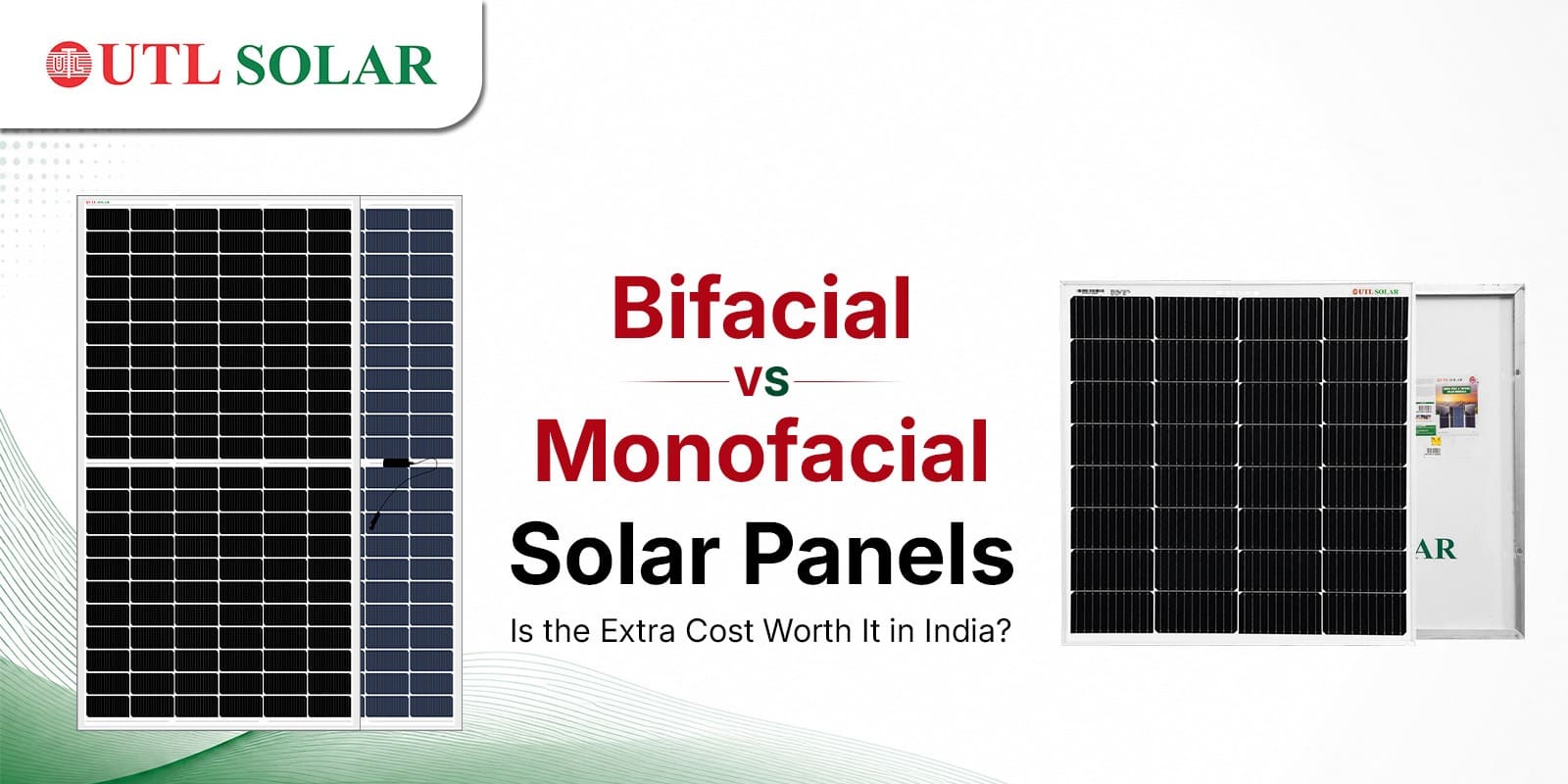
Bifacial panels pull power from both their front and back sides, using reflected light to squeeze out extra output beyond what a standard single-sided panel manages. They also cost more. Whether that extra cost is worth paying comes down to your roof, specifically whether there’s enough clearance and reflective surface underneath for the rear side to generate additional power.
What actually makes a panel bifacial?
A monofacial panel has active cells on one side, the side facing the sun, backed by a solid sheet that provides structural support but does not generate electricity. A bifacial panel swaps that solid backsheet for glass and active cells on both faces, so it can pick up direct sunlight from the front and whatever bounces off the ground onto the back.
The amount of reflected light depends on a property’s albedo, or how reflective the surface beneath the panel is. A white terrace, gravel, sand, even snow in colder regions – all of it reflects enough light to make a difference on the rear side.
Where do bifacial panels actually perform best?
Give them clearance and a reflective surface underneath, and bifacial panels do genuinely well. That’s why you’ll find them all over large ground-mounted solar farms, elevated on open structures above pale ground that bounces light straight back up.
Rooftops in India rarely offer that setup. Most residential racking sits close to the roof, which limits how much light ever reaches the panel’s back side. A light-coloured terrace or elevated open-frame mounting changes the math somewhat, while dark roofing and low-clearance mounting mostly cancel out the advantage.
How much more do bifacial panels cost than standard monofacial panels?
Bifacial panels generally cost more, although the difference isn’t due to bifaciality alone. Module construction, cell technology (such as TOPCon), dual-glass design, manufacturer, warranty and market conditions all influence pricing. For a broader comparison of current solar panel prices, including the latest technologies available in India, see our solar panel price guide.
How much extra output can you realistically expect on a rooftop?
Here’s where marketing and reality tend to part ways. The bifacial gain figures manufacturers advertise are usually measured under ideal, elevated ground-mount conditions, not the close-roof setup most homes actually get. On a typical residential install with moderate clearance and reflectivity, expect the additional yield to be real but modest, not the headline numbers you’ll see in a brochure. The gain only really shows up when both clearance and surface reflectivity are working in your favour, and that combination isn’t common on Indian rooftops without deliberately designing for it.
None of this means bifacial panels underperform. It just means the advertised ceiling doesn’t automatically apply to your roof.
Here’s the comparison:
| Metrics | Bifacial | Monofacial |
|---|---|---|
| Active cells | Both front and back | Front only |
| Backing material | Glass on both sides | Solid backsheet |
| Power source | Direct sunlight + reflected light (albedo) | Direct sunlight only |
| Typical output gain | 5–20%+ over monofacial, but only under ideal conditions | Baseline |
| Best mounting | Elevated, open-frame, reflective surface below | Any standard mounting, including close-roof |
| Rooftop performance (India) | Modest gain on close-mounted sloped roofs; better on flat, light-coloured terraces | Consistent, predictable output regardless of surroundings |
| Price per watt | Higher | Lower |
| Ideal use case | Ground-mount solar farms, elevated open racking, reflective surfaces | Standard sloped or close-mounted residential rooftops |
| Durability | Comparable, sometimes better wear resistance from dual-glass build | Comparable, depends more on brand/build quality |
| Subsidy eligibility (PM Surya Ghar) | Yes, if DCR and MNRE-compliant | Yes, if DCR and MNRE-compliant |
Is it worth it for a typical Indian home?
If your roof is sloped, low-clearance, and covered in average or dark roofing material, the extra cost of going bifacial probably won’t pay itself back through the small additional yield. A standard Mono PERC panel is the more sensible pick in that situation.
If instead you’ve got a flat, light-coloured terrace or elevated open-frame mounting, bifacial starts to make more financial sense over the system’s lifetime. Not sure which camp your roof falls into? Ask your installer for a site-specific assessment rather than going by general marketing claims, since roof conditions vary enough that guesswork isn’t reliable here.
Ultimately, the right choice depends less on the panel itself than on how and where it’s installed. Before paying extra for bifacial modules, ask your installer to estimate the expected bifacial gain for your specific roof rather than relying on generic marketing figures.
Frequently Asked Questions
Do bifacial panels need special mounting?
Ideally, yes. They do best with elevated, open-frame mounting that gives light a clear path to the rear side. Standard close-roof mounting still works fine, just with a smaller bifacial gain.
Are bifacial panels eligible for subsidy?
Yes. Both bifacial and monofacial panels can qualify under the PM Surya Ghar: Muft Bijli Yojana scheme, as long as they meet DCR and MNRE-approved vendor requirements. Panel technology has nothing to do with it. If you’d rather start from a subsidy-eligible, DCR-compliant package than pick components one by one, UTL’s ShineX solar systems offer Mono PERC and TOPCon options built with straightforward subsidy approval in mind.
Do bifacial panels work well on standard sloped roofs?
Yes, though with less of an edge. Front-side generation is unaffected, but the rear-side bonus shrinks considerably on a sloped roof with low clearance and darker material underneath.
Are bifacial panels more durable than standard monofacial panels?
Not inherently, no, just built differently. The dual-glass design can hold up better against certain wear, but overall durability comes down more to build quality and brand than to whether a panel happens to be bifacial.
Is the bifacial gain the same for every rooftop?
No, not even close. Mounting clearance, surface reflectivity, and roof colour all swing the result, which is why identical panels can perform quite differently on two different roofs.
Do bifacial panels cost more to install, not just to buy?
Sometimes, yes. Getting meaningful rear-side gain often calls for elevated or open-frame mounting structures, and those can add to installation costs compared to standard close-roof setups.
The Union Cabinet just cleared the Pradhan Mantri Surya Sarovar Yojana, PM-SSY, for Rs 5,070 crore, 5,000 MW of floating solar on India’s reservoirs and industrial ponds, and no fresh land needed to get there. Rollout runs FY 2026-27 to FY 2030-31.
Think of it as the next chapter after PM Surya Ghar. Same push, different surface; this one plays out on water instead of rooftops. Here’s the breakdown and why it’s worth knowing even if you’ve got zero plans to build a utility-scale plant yourself.