What Is PM Surya Ghar 2.0? Everything Reported So Far
The Ministry of New and Renewable Energy (MNRE) is reportedly working on a redesigned version of India’s rooftop solar scheme, informally referred to as PM Surya Ghar 2.0. Based on recent media reports, the update would shift the program from rewarding installed capacity alone to rewarding actual power generation, add support for battery storage, and extend benefits to households that currently can’t access the scheme. None of this is a confirmed policy yet. It’s under discussion at the ministry level, and UTL Solar will update this page as soon as anything is formally announced.
Where Things Stand Today
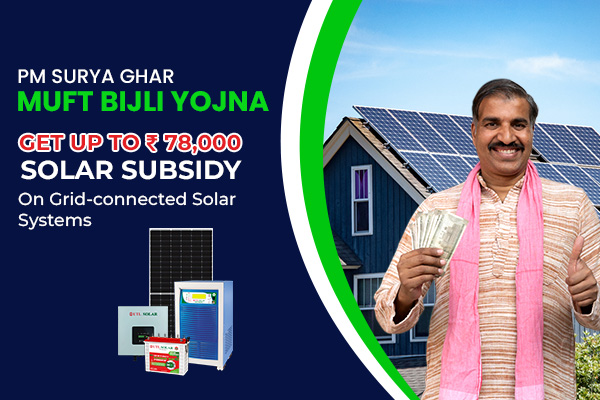
PM Surya Ghar: Muft Bijli Yojana has been running since February 2024, with an outlay of over Rs 75,000 crore and a target of solarising 1 crore households by FY 2026-27. The central subsidy is currently capped at Rs 78,000 for a 3 kW system, calculated on solar capacity alone. Battery storage isn’t part of the subsidy math today, and applicants without a suitable rooftop, such as apartment residents, largely sit outside the scheme.
That’s the gap PM Surya Ghar 2.0 is reportedly trying to close.
What’s Reportedly Under Discussion
1. Subsidies Linked to Generation, Not Just Capacity
Rather than a flat payout for the system size installed, future subsidies and incentives may be tied to actual power generated and long-term performance. The idea is to reward systems that keep producing, not just systems that get installed and forgotten.
2. Battery Storage Support
Officials are reportedly discussing battery storage at both the household and community levels to store solar power for use during non-solar hours and improve grid stability. This would be a meaningful shift, since battery storage is currently permitted under the scheme but isn’t separately subsidised; the central payout stays capped at 3 kW of solar PV capacity regardless of whether a battery is added.
3. Expanded Accessibility
The proposed update would extend benefits to people who can’t currently participate, including apartment residents and low-income households without a suitable rooftop. The route being discussed involves shared community solar plants, balcony solar units, and virtual net metering, so eligibility would no longer depend on owning a rooftop.
4. Digital Solar Passports
A common data protocol and “Digital Solar Passport” system are reportedly being explored to track a system’s output, service history, and warranty status in real time. For consumers, this would mean a verifiable, portable record of how their system is actually performing, useful at resale, during warranty claims, or when switching service providers.
What This Would Mean for Homeowners
If these proposals go through as reported, three things change for the average household:
Performance will matter more than paperwork: A well-maintained, well-generating system stands to gain more under a generation-linked subsidy model.
Battery backup gets easier to justify financially: Right now, battery storage is a separate out-of-pocket cost. Subsidy support would change that math meaningfully for households in high-outage areas.
More households become eligible: Apartment dwellers and those without a usable rooftop, currently locked out of the scheme, would get a path in through shared and community models.
What Hasn’t Changed
The current PM Surya Ghar scheme, subsidy slabs, application process, and eligibility rules remain unchanged. Nothing about PM Surya Ghar 2.0 has been formally notified by MNRE. Homeowners planning an installation now should apply under the existing scheme rather than wait, since there’s no confirmed timeline for when, or in what form, these changes would take effect.
UTL Solar will track this story as it develops and update this page with confirmed details once MNRE issues formal guidelines.
FAQs
Is PM Surya Ghar 2.0 an official government scheme? Not yet. As of now, it’s a set of proposals reportedly under discussion at MNRE. No official notification has been issued.
Will battery storage get a subsidy under PM Surya Ghar 2.0? This is one of the changes being discussed: battery storage at the household or community level, but it hasn’t been confirmed or notified yet.
Can apartment residents apply for PM Surya Ghar 2.0? Under the proposals being discussed, yes, through shared community solar plants, balcony solar, and virtual net metering. This isn’t available under the current scheme.
What is a digital solar passport? It’s a proposed digital record, tied to a common data protocol, that would track a solar system’s output, service history, and warranty status in real time.
Should I wait for PM Surya Ghar 2.0 before installing solar? No. The current PM Surya Ghar scheme is fully operational with defined subsidies and timelines. Since PM Surya Ghar 2.0 has no confirmed rollout date, waiting means delaying real savings on an unconfirmed timeline.
Where can I check the latest official updates? The MNRE’s official portal, pmsuryaghar.gov.in, is the authoritative source for any confirmed scheme changes.