On-Grid vs Off-Grid Solar System: Which One Is Right for Your Home?
Choosing the right residential solar system depends on factors such as grid availability, electricity consumption patterns, and the frequency of power outages. Based on these requirements, homeowners typically choose between two primary solar configurations: on-grid and off-grid systems.
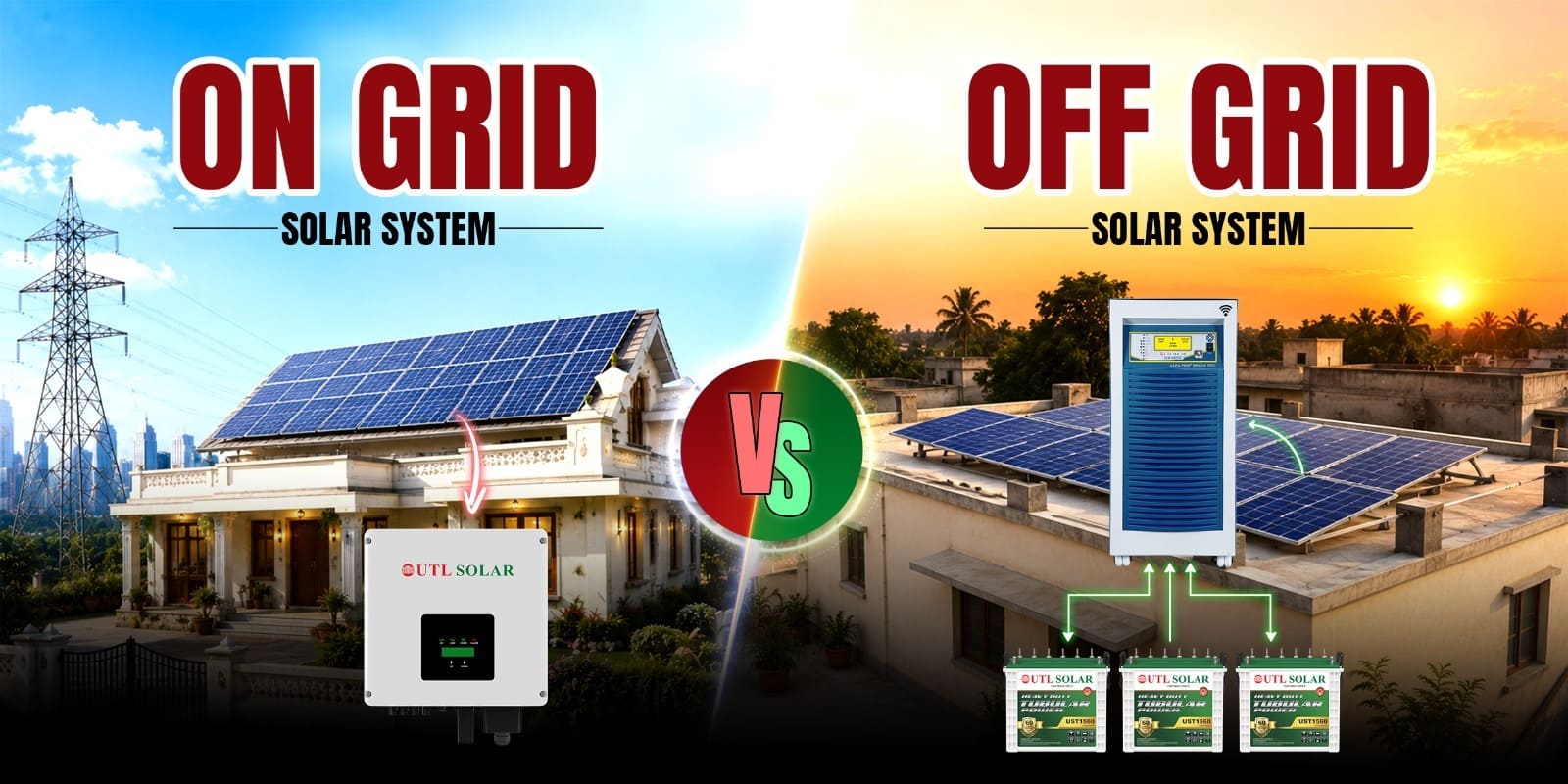
While both systems generate electricity from sunlight, they differ in how they store, manage, and supply power. An on-grid system operates alongside the utility grid, whereas an off-grid system functions independently through battery-based energy storage.
These differences can affect electricity savings, power availability during outages, system design, and overall investment requirements. Understanding how each configuration works can help homeowners identify the option that best aligns with their energy needs and long-term expectations.
In this guide, we’ll compare on-grid and off-grid solar power systems, examine their advantages and limitations, and explore the scenarios where each system is most suitable.
On-Grid vs Off-Grid Solar Energy System: A Quick Comparison
Before exploring each system in detail, it is helpful to understand how on-grid and off-grid PV systems differ in overall functionality. The table below provides a quick comparison at a glance of both solar setup types.
| Factor | On-Grid Solar System | Off-Grid Solar System |
|---|---|---|
| Grid Connection | Connected to the utility grid | Can work with or without a utility grid connection. But not dependent on the grid availability |
| Battery Requirement | Typically not required | Required for energy storage |
| Subsidy Eligibility | Residential rooftop solar system are eligible for government subsidies under PM Surya Ghar Yojana. | Generally not eligible under solar subsidy schemes |
| Grid Export | Can export surplus electricity to the grid through net metering mechanisms | Cannot export electricity to the grid when operating independently |
| Initial Investment | Generally lower due to no need of battery bank | Generally higher because of battery storage requirements |
| Electricity Supply at Night | Draws electricity from the grid | Uses energy stored in batteries |
| Backup Power Capability | Standard systems typically do not operate during outages | Can continue supplying power if sufficient stored energy is available in the battery |
| Maintenance Requirements | Usually involves fewer components | Includes battery maintenance and monitoring considerations |
| Suitable Applications | Homes with reliable grid access | Remote areas or locations with limited grid availability or frequent outages |
What Is an On-Grid Solar System?
An on-grid or grid-tie power setup operates with the local utility grid. The system generates electricity from sunlight, while the grid remains available to provide electricity whenever the PV system is unable to meet the home’s power requirements. When solar generation exceeds household consumption, surplus electricity may be exported to the grid through net metering, subject to local utility policies and regulations.
How Does an On-Grid Solar Setup Work?
An on-grid system generates electricity when solar panels capture sunlight and convert it into Direct Current (DC) power. The solar inverter then converts this DC electricity into Alternating Current (AC) electricity for use by household appliances.
During periods when the photovoltaic system cannot generate enough electricity to meet the home’s demand, additional power is drawn from the utility grid. Conversely, if the system produces more electricity than is being consumed, the surplus can be exported to the grid through net metering, subject to applicable utility policies and regulations.
Advantages of an On-Grid PV System
Utilizes the utility grid as a supplementary source of electricity when solar generation is unavailable or insufficient.
1. Lower Upfront Cost
On-grid systems do not require battery storage, which significantly reduces the overall installation cost.
2. Net Metering Benefits
Excess electricity generated during the day can be exported to the grid that allows consumers to receive credits that help offset future electricity consumption.
3. Government Subsidy Eligibility
Eligible homeowners may receive financial assistance of up to ₹78,000 under the PM Surya Ghar: Muft Bijli Yojana for qualifying residential rooftop solar installations. This support can help reduce the overall investment required and improve the financial viability of adopting solar energy.
4. Lower Maintenance Requirements
The absence of batteries reduces maintenance needs and removes concerns related to battery health, replacement, and storage management.
5. Improved Return on Investment
Lower installation costs combined with electricity bill savings and net metering credits can result in a more attractive financial return over the system’s lifetime.
6. Efficient Use of Excess Solar Generation
Any surplus electricity can be fed into the grid rather than being curtailed or stored, helping maximize the value of the energy produced.
7. Access to Grid Power When Needed
When solar production falls below demand, such as during nighttime hours or cloudy weather, electricity can be drawn directly from the grid without requiring large battery capacity.
What Is an Off-Grid Solar System?
An off-grid solar setup is a standalone solar power system that operates without a connection to the utility grid. It generates electricity through solar panels and stores excess energy in batteries for use when solar generation is unavailable or insufficient. Because the system relies on its own solar production and battery storage to meet electricity demand, it is commonly used in locations with limited, unreliable, or no access to grid power.
How Does an Off-Grid Solar System Work?
An off-grid setup generates Direct Current (DC) electricity through solar panels when exposed to sunlight. This electricity is supplied to an inverter, which converts it into Alternating Current (AC) electricity for use by household appliances and electrical equipment. During periods of strong solar generation, the system powers connected loads while any surplus energy is stored in batteries.
When solar production becomes insufficient or stops altogether, such as during nighttime hours or cloudy weather, the system draws upon the energy stored in the batteries to continue supplying electricity. In this way, the battery bank serves as an energy reserve which allows the system to provide power even when the solar panels are not actively generating electricity.
Advantages of an Off-Grid Solar Solution
- Provides electricity in locations where utility grid access is unavailable.
- Continues supplying power during utility grid outages because it operates independently of the grid.
- Stores surplus solar energy for use during low solar generation and when sunlight is unavailable.
- Offers greater energy self-sufficiency by relying on on-site solar generation and battery storage.
- Maintains power availability in areas with frequent or prolonged grid interruptions.
What if you need both?
For homeowners who want to reduce electricity bills while also maintaining access to stored backup power, a hybrid solar system may be worth considering. By combining grid connectivity with battery storage, a hybrid setup can offer many of the benefits associated with both on-grid and off-grid configurations which make it a suitable option for properties that require both energy savings and enhanced power availability.
Which Solar Option Is Right for Your Home?
The suitability of an on-grid or off-grid solar energy setup depends largely on local conditions and household requirements.
Homes With Reliable Grid Power
Where grid electricity is consistently available, an on-grid system can help reduce electricity bills by offsetting a portion of the property’s energy consumption with solar power, while still allowing access to grid electricity whenever solar generation is insufficient and unavailable.
Areas With Frequent Power Outages
In locations that experience regular power interruptions, an off-grid solar energy system may be a more suitable option because it stores energy in batteries and can continue supplying electricity when grid power is unavailable.
The suitability of an on-grid or off-grid solar energy setup depends largely on local conditions and household requirements.
Remote Locations
For properties located far from utility infrastructure, extending grid connections can be difficult and expensive. In such cases, an off-grid PV setup can provide a self-sufficient source of electricity without requiring access to the utility grid.
Budget Considerations
Budget is often a major deciding factor, as off-grid configurations typically require battery storage in addition to solar generation equipment. It results in a higher upfront investment than comparable on-grid installations.
Energy Independence Requirements
Homeowners who want to generate and store their own electricity without relying on the utility grid may find an off-grid configuration better aligned with their long-term energy goals. Because the system operates independently of grid power, it can provide greater control over energy supply and reduce dependence on external electricity sources.
Final Thoughts
There is no universally superior configuration between on-grid and off-grid solar systems. The right choice depends on factors such as grid reliability, backup power requirements, energy consumption patterns, and budget considerations. A solution that performs exceptionally well in one scenario may be less suitable in another.