What Happens to Your Solar System During a Power Surge? (Real Risks & Solutions Explained)
Most solar power systems are designed with one goal in mind, consistent and long-term performance, often operating continuously for 25 years or more. And for the most part, they deliver. But that reliability often leads to a blind spot: what happens when the system is exposed to conditions it wasn’t built to handle?
Electrical disturbances, especially sudden voltage spikes, fall into that category. They don’t occur every day, and when they do, the impact is almost instantaneous. Because a solar setup is connected across both the panel side and the grid, these spikes can travel through multiple pathways and reach sensitive components within seconds..
The issue isn’t just immediate damage. In many cases, the system continues to run, but with hidden stress on critical parts like the solar inverter and battery, which can show up later as reduced efficiency or unexpected failure.
In this guide, we’ll take a closer look at what actually happens inside a solar system during a power surge, where the real risks lie, and what practical steps can help protect your setup.
What Is a Power Surge in a Solar System?
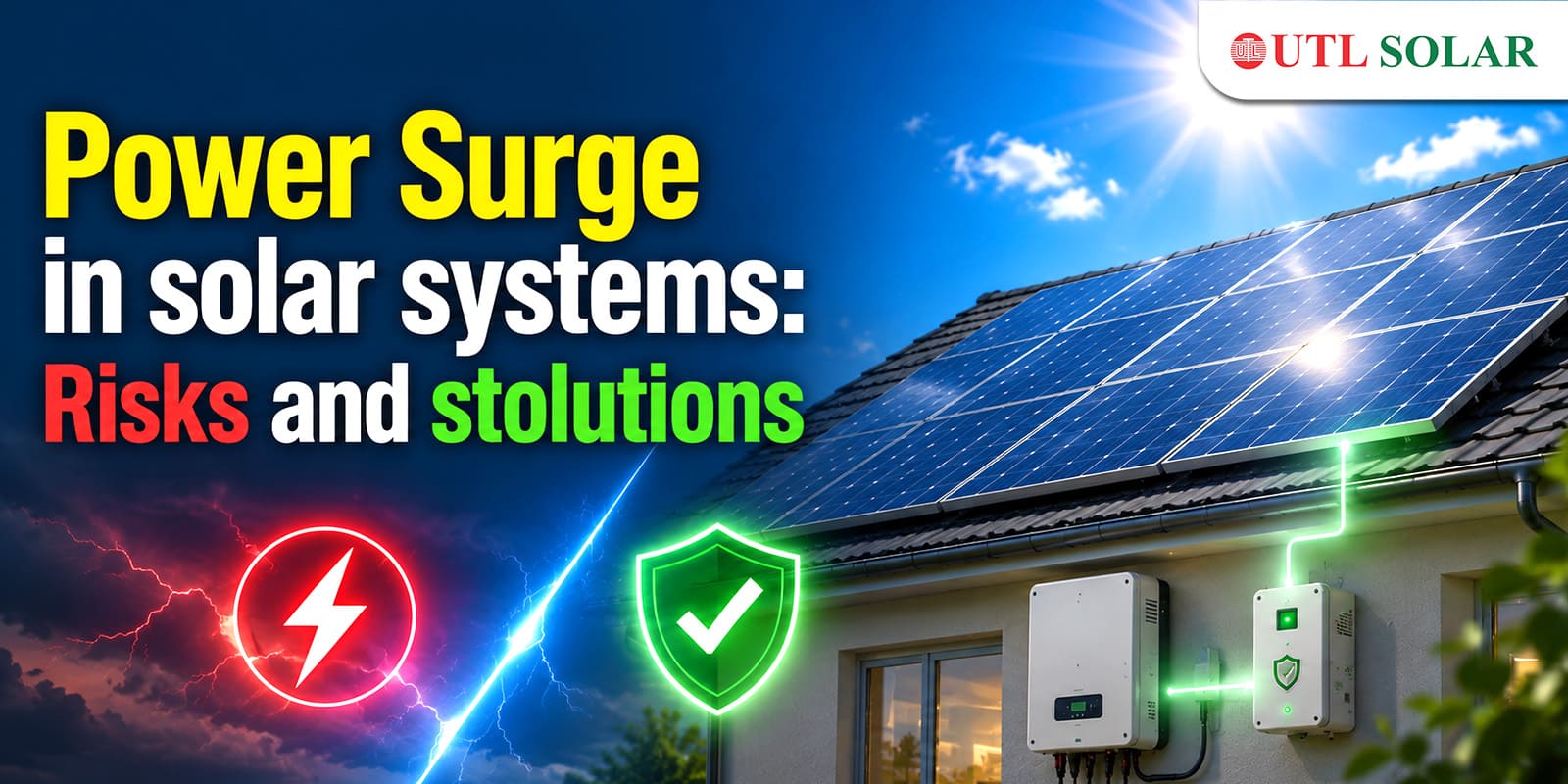
A power surge is a sudden and short-lived increase in voltage that exceeds the normal operating level of an electrical system. In a solar setup, this spike can originate from external sources like lightning or grid disturbances, or from internal events such as switching operations and load changes.
What makes surges particularly important in solar systems is how they propagate. Unlike traditional electrical setups, solar installations have two active sides, the DC side (solar panels and wiring) and the AC side (grid connection and home loads). A surge entering from either side can quickly spread across the system and affect multiple components almost simultaneously.
How a Power Surge Travels Through Your System
When a surge occurs, it follows the available electrical paths while moving through cables, circuits, and connected devices.
- From the DC side: A lightning-induced surge or atmospheric discharge can enter through the solar panels and travel toward the inverter.
- From the DC side: A lightning-induced surge or atmospheric discharge can enter through the solar panels and travel toward the inverter.
Since the inverter acts as the central conversion (it converts DC power to usable AC power) point, it often becomes the most exposed part of the system. From there, the surge can impact batteries, charge controllers, and even sensitive connected appliances.
Real Risks of Power Surges in Solar Systems
Understanding how a surge travels is only part of the picture. The real concern is what it leads to over time, both immediate failures and long-term performance issues.
Immediate Equipment Failure
Components like the inverter or charge controller can fail instantly in high-intensity events, especially lightning-induced surges. This usually results in a complete system shutdown and requires immediate replacement.
Hidden Performance Degradation
Repeated minor surges can weaken internal circuits which leads to:
- Reduced energy conversion efficiency
- Inconsistent power output
- Increased system losses over time
These issues often go unnoticed until there’s a measurable drop in performance.
Reduced Lifespan of Critical Components
Surge exposure accelerates wear in sensitive parts like batteries and inverters. What’s designed to last 5–10 years may fail much earlier under repeated electrical stress.
Risk to Connected Appliances
If a power surge enters your solar system and passes through the inverter, it doesn’t stop there. The inverter is directly connected to your home’s electrical panel, which means any excess voltage can be carried into your internal wiring and reach connected appliances.
Most household devices are designed to handle small voltage variations, not sudden spikes. Whether they survive a surge depends on the level of protection built into them.
What happens When a High-voltage Spike Reaches your Appliances:
- Low-end devices (fans, lights, basic electronics) may fail immediately
- Sensitive electronics (TVs, routers, computers) can suffer circuit board damage
- Appliances with motors or comp ressors (refrigerators, ACs) may experience insulation stress or reduced lifespan
In some cases, the device stops working right away. In others, it continues running but with internal damage that leads to failure later.
How to Protect Your Solar System from Power Surges
Once you understand how surges move through a solar system and what they can damage, now the question arises that how do you stop that damage from happening?
Use Surge Protection Devices (SPDs)
Surge Protection Devices are designed to divert excess voltage safely to the ground before it enters critical parts of your system.
In a solar setup, protection needs to be applied at multiple points:
- DC-side protection: Installed between solar panels and the inverter to block surges coming from the panel side.
- AC-side protection: Installed between the inverter and the main distribution board to handle grid-side surges
Installing only one side leaves the other exposed. For full protection, both are required
How Surge Protection Devices Actually Work
Surge Protection Devices (SPDs) redirect the voltage spikes before they can reach sensitive components. Under normal conditions, an SPD remains inactive and allows electricity to flow as usual. But the moment voltage rises beyond a safe threshold, it reacts almost instantly. It follows a simple but critical sequence:
- Detection
The SPD continuously monitors voltage levels. When it detects a spike beyond its rated limit, it activates within microseconds. - Diversion
The SPD creates a low-resistance path that diverts the surge away from critical components like the inverter. - Grounding
The excess energy is safely discharged into the earthing system. This step is crucial, without proper grounding, the surge has nowhere to go. - Reset
Once voltage returns to normal, the SPD automatically returns to standby mode and continues monitoring.
Core Types of Surge Protection Devices for Solar Systems
In solar systems, SPDs are typically classified as Type 1, Type 2, or Type 3 devices based on their surge discharge capability and intended installation location.
1. Type 1 SPD (Lightning Current Arresters)
Type 1 SPDs are designed to handle high-energy surges caused by direct lightning strikes or nearby lightning events. These are typically installed at the main distribution board where the power enters the facility.
In solar applications, Type 1 SPDs are essential in areas with high lightning exposure or where an external lightning protection system (LPS) is installed. They prevent large surge currents from entering and damaging the connected equipment.
2. Type 2 SPD (Surge Arresters)
They protect solar inverters and other electrical equipment from indirect surges caused by switching operations or distant lightning strikes.
These are usually installed at sub-distribution panels and near the inverter on both DC and AC sides.
3. Type 3 SPD (Point-of-Use Protection)
Type 3 SPDs are installed close to the load to provide additional protection for equipment such as data loggers, monitoring systems, smart meters, and communication devices.
While they cannot handle high-energy surges independently, they work in coordination with Type 1 and Type 2 SPDs to offer layered protection.
Ensure Proper Earthing (Grounding)
Surge protection only works if excess voltage has a safe path to dissipate. That path is your grounding system.
- Poor or high-resistance earthing reduces the effectiveness of SPDs.
- All major components like solar panels, inverter, and distribution board, should be properly grounded.
Without earthing, even the best protection devices won’t perform as intended.
How Surge Protection Drives Higher ROI in Solar Systems
Surge protection is often viewed as a safety add-on, but in reality, it plays a direct role in improving the financial performance of a solar system.
- Prevents Costly Equipment Failures
- Minimizes System Downtime
- Extends Equipment Lifespan
- Protects Energy Yield and Savings
- Reduces Maintenance and Replacement Costs
Must-Have Features in Surge-Protected Solar Inverters
- Integrated Type II Surge Protection on AC and DC Circuits
- Designed for Effective Grounding Integration
- Durable & Weather-Resistant Enclosure
- Adherence to Global Safety and Performance Standards
Final Thought
A solar system is a long-term investment, but its performance can be compromised by a voltage spike that lasts only a fraction of a second. The challenge is that surge-related damage is not always visible immediately. In many cases, it appears later as reduced efficiency, unexpected downtime, or premature equipment replacement.
That is why surge protection should be viewed as a core part of system design rather than an optional add-on. By combining properly selected SPDs with effective grounding, homeowners can protect critical equipment and maximize the return on every unit of power their system generates over its lifetime.