Is India Truly on Track to Reach 500 GW of Non-Fossil Fuel Capacity by 2030?
India’s clean energy transition has moved from a future aspiration to immediate economic and strategic priority. Rising energy demand, climate commitments, geopolitical uncertainty, and industrial competitiveness are pushing nations to accelerate renewable energy deployment at unprecedented scale. In this global transition, India has emerged as one of the most closely watched energy markets with its target of achieving 500 GW of non-fossil fuel capacity by 2030.
The ambition is substantial, the momentum is visible, and the global implications are significant. Yet the scale of transformation required extends far beyond renewable capacity additions alone. The defining question now centers on execution: can India modernize its infrastructure, strengthen grid resilience, and scale implementation fast enough to deliver one of the world’s most ambitious energy transitions?
Why the 500 GW Target Matters
India’s 500 GW non-fossil fuel target reflects a major shift in the country’s approach to economic growth, energy security, and industrial competitiveness. As one of the world’s fastest growing economies, India is expected to drive a significant share of future global energy demand, fueled by rapid urbanization, manufacturing expansion, digital infrastructure growth, and rising electrification across sectors.
Reducing dependence on imported fossil fuels has therefore become both an economic and strategic priority. In recent public addresses, Prime Minister Narendra Modi has repeatedly emphasized how global geopolitical tensions and oil price volatility continue to impact energy importing nations like India. Expanding domestic renewable capacity can strengthen energy resilience, reduce exposure to external market shocks, and support economic stability through greater energy independence.
The target also aligns with rising global ESG expectations and decarbonization commitments that increasingly influence investment decisions and capital flows. Beyond climate action, India’s renewable transition is emerging as a broader strategy for infrastructure modernization, manufacturing growth, and geopolitical positioning.
India’s Renewable Energy Progress So Far
India’s renewable energy expansion has accelerated rapidly over the last decade, with solar energy emerging as the largest contributor to new power capacity additions. According to the Ministry of New and Renewable Energy (MNRE), India’s cumulative renewable energy capacity reached approximately 279 GW by April 2026 which includes over 154 GW of installed solar capacity and more than 56 GW of wind capacity. Solar installations alone have expanded from less than 3 GW in 2014 to more than 154 GW that highlights the scale of growth achieved within a relatively short period.
This growth has been supported by falling solar module prices, competitive utility scale bidding, stronger domestic manufacturing initiatives, expanding private sector investment, and large scale policy programs such as solar parks, rooftop solar adoption, and transmission infrastructure development. India added nearly 28 GW of new solar and wind capacity during 2024, followed by an additional 16.3 GW within the first five months of 2025 alone which reflects the increasing pace of deployment across the sector.
India has also achieved a major national energy milestone by crossing 50% of installed electricity capacity from non-fossil fuel sources ahead of its Paris Agreement target timeline. As of mid 2025, non-fossil fuel capacity had reached approximately 242.8 GW out of a total installed power capacity of 484.8 GW. This includes contributions from solar, wind, hydro, biomass, and nuclear energy infrastructure.
Policy Support and Institutional Momentum
Government policy has played a central role in accelerating renewable energy deployment and improving investor confidence. Initiatives such as the Production Linked Incentive (PLI) Scheme for High Efficiency Solar PV Modules aim to strengthen domestic manufacturing capabilities and reduce import dependence within the solar supply chain. The Renewable Energy Corridor Programme has further supported grid integration by expanding transmission infrastructure for renewable-rich regions to help in addressing one of the sector’s long standing structural constraints.
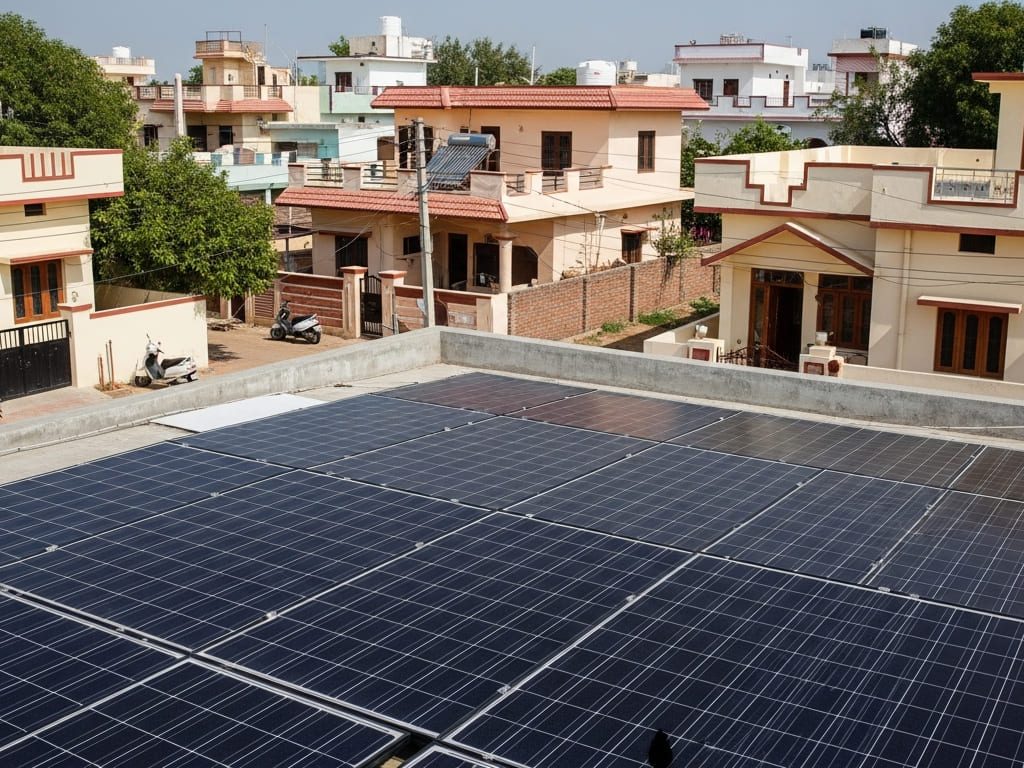
The National Green Hydrogen Mission signals India’s intention to build a future oriented clean industrial ecosystem beyond power generation alone. The programme is expected to support investments across hydrogen production, storage, export infrastructure, and industrial decarbonisation. Similarly, the PM Surya Ghar: Muft Bijli Yojana has increased policy attention on distributed renewable adoption by encouraging rooftop solar deployment at the household level.
These policy interventions have strengthened market visibility for future investors while improving the commercial viability of renewable projects. Declining solar and wind generation costs have also enhanced competitiveness against conventional power sources and positioned renewable energy as both an environmental priority and an increasingly attractive infrastructure investment segment.
The Real Bottlenecks Slowing Progress
Despite strong policy momentum and rising investment activity, India’s renewable energy transition still faces several structural and execution related challenges. The long term opportunity remains substantial, but the pace of expansion increasingly depends on solving operational and infrastructure bottlenecks.
Land Acquisition Delays
Large scale solar and wind projects require significant land availability. Delays linked to approvals, ownership disputes, environmental clearances, and local coordination often slow project execution and increase development costs.
Potential Way Forward: Faster land approval mechanisms and improved state level coordination could help reduce execution delays.
Transmission and Grid Constraints
Renewable capacity additions are expanding faster than transmission infrastructure in several regions. Grid congestion and inadequate evacuation networks can restrict the efficient transfer of renewable power from generation sites to demand centres.
Potential Way Forward: Accelerated investment in transmission infrastructure and grid modernisation will be critical to support future renewable expansion.
Renewable Energy Evacuation Challenges
States with high renewable generation capacity frequently face curtailment risks due to insufficient grid connectivity. Although the Renewable Energy Corridor Programme has improved transmission planning, evacuation infrastructure still requires faster expansion.
Potential Way Forward: Better synchronisation between renewable project approvals and transmission planning may improve power evacuation efficiency.
Financing and Capital Access Issues
Investor interest remains strong, but access to affordable financing is uneven across the sector. Smaller developers often face higher borrowing costs, while interest rate volatility can affect project economics and sustained returns.
Potential Way Forward: Expanding access to blended finance, green bonds, and long term infrastructure capital could improve funding availability.
Delays in Power Purchase Agreements (PPAs)
Execution delays in signing or approving PPAs continue to create uncertainty for developers. These delays can disrupt project timelines, financing schedules, and revenue visibility.
Potential Way Forward: Faster approval timelines and greater contractual consistency across states may improve investor confidence.
Financial Stress Among DISCOMs
The financial condition of state distribution companies (DISCOMs) remains a major concern. Delayed payments from DISCOMs can affect cash flows, reduce investor confidence, and increase financial pressure across the renewable value chain.
Potential Way Forward: Structural DISCOM reforms and improved payment discipline remain essential for lasting sector stability.
Regulatory and Execution Uncertainty
Policy direction at the national level remains supportive, but state level implementation can vary considerably. Approval delays, changing regulations, and contract renegotiation concerns continue to affect project execution.
Potential Way Forward: Greater regulatory consistency and predictable policy implementation could strengthen future investment visibility.
Intermittency and Energy Storage Limitations
Solar and wind energy generation depends on weather conditions which create intermittency challenges for grid stability. As renewable penetration rises, investments in battery storage, grid balancing systems, and flexible infrastructure will become increasingly important.
Potential Way Forward: Scaling battery storage capacity and flexible grid technologies will be important for improving renewable reliability.
India’s renewable energy outlook remains structurally strong. However, the sector’s next phase of growth will depend less on policy ambition and more on execution efficiency, infrastructure readiness, and long term financial sustainability.
Final Thought
India’s renewable energy transition has moved beyond an emerging growth narrative into a large-scale economic and infrastructure transformation. The sector now sits at the intersection of energy security, industrial expansion, technological modernization, and strategic capital deployment.
The next decade will likely determine how effectively India converts policy ambition into durable infrastructure capacity at scale. As global clean energy markets continue to evolve, India’s progress will increasingly carry significance far beyond its domestic energy landscape.