
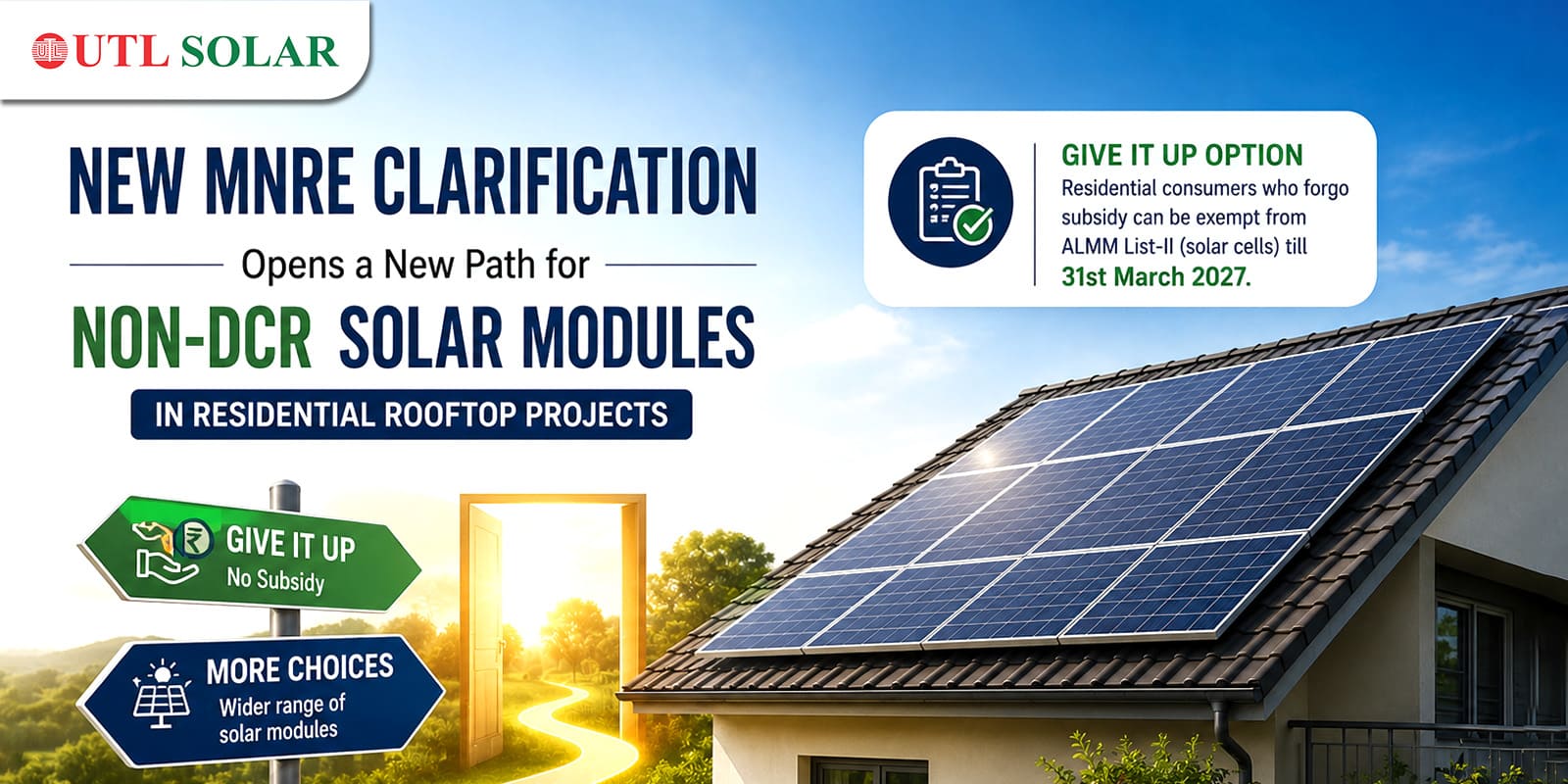
India’s residential solar sector received an important policy clarification on 8 June 2026 after the Ministry of New and Renewable Energy (MNRE) addressed questions surrounding ALMM List-II compliance for certain consumers under PM Surya Ghar: Muft Bijli Yojana.
The clarification relates to homeowners who voluntarily choose the “Give It Up” option under the scheme and do not claim Central Financial Assistance (CFA). While the update applies only to a specific category of residential consumers, it introduces a distinction that could influence procurement decisions, technology selection, and project planning across a growing segment of the rooftop solar market.
MNRE Clarifies Scope of ALMM Exemption
According to the Office Memorandum issued by MNRE, residential net-metering consumers who opt for the “Give It Up” category under PM Surya Ghar will be exempt from the applicability of ALMM List-II requirements for solar PV cells until 31 March 2027, provided their applications are submitted through the PM Surya Ghar National Portal.
The clarification was issued following representations received by the ministry seeking guidance on whether consumers who voluntarily forego subsidy benefits would still be required to comply with ALMM List-II provisions applicable to solar cells.
The ministry has now confirmed that such consumers fall within a limited exemption framework for the remaining duration of the scheme.
The exemption does not extend to other rooftop solar projects and does not alter existing requirements for consumers claiming subsidy benefits under PM Surya Ghar.
Residential Solar Procurement Gets a New Category
Until now, discussions around residential rooftop solar have largely revolved around subsidy eligibility, DCR requirements, and compliance with approved manufacturing lists.
The latest clarification effectively creates a separate category within the residential market.
On one side are consumers seeking government incentives and subsidy-linked installations. On the other are homeowners willing to proceed without subsidy support in exchange for greater flexibility in module selection.
For installers and project developers, this distinction creates a different procurement environment from what has traditionally existed in the residential segment.
As electricity consumption continues to rise due to electric vehicles, air conditioning, home automation systems, and higher household energy demand, an increasing number of consumers are evaluating rooftop solar primarily as a long-term energy investment rather than a subsidy-driven purchase.
A Market Beyond Subsidy Eligibility
India’s rooftop solar market has evolved significantly over the past few years.
While subsidy-supported installations remain an important driver of residential adoption, there is also a growing group of consumers focused on system performance, lifetime energy generation, and future electricity requirements.
These consumers often evaluate factors such as module efficiency, degradation rates, inverter performance, warranty coverage, and projected energy yield over 25 years or more.
For this segment, technology selection can play a larger role than upfront financial assistance.
The latest clarification provides additional flexibility for such homeowners while preserving the existing framework for consumers who continue to benefit from government support.
Technology Choices Come Into Focus
The clarification arrives at a time when solar module technology is advancing rapidly across global and domestic markets.
Over the past two years, manufacturers have steadily increased module wattages through TOPCon cell technology, larger wafer formats, improved module architecture, and bifacial designs.
Higher-efficiency modules have become increasingly common across commercial, industrial, and utility-scale projects where maximizing energy generation per installation is a key objective.
The same technology trends are gradually influencing residential solar as homeowners seek systems capable of supporting larger loads and future energy requirements.
As a result, conversations around module selection are increasingly extending beyond compliance requirements to include long-term performance metrics.
High-Wattage Modules Continue to Expand Their Presence
The Indian solar industry has witnessed a steady transition toward higher-output modules.
Several manufacturers have expanded their portfolios with advanced TOPCon bifacial modules exceeding 600Wp, reflecting broader efforts to improve power density and generation efficiency.
The category now includes 630Wp-class modules built on modern G12R cell architectures, combining higher wattage with practical module dimensions suitable for a range of applications.
Manufacturers investing in next-generation TOPCon platforms are positioning themselves to meet demand from customers seeking greater energy output from every installed module.
Procurement Decisions May Evolve
For EPC companies, solar installers, and distributors, the clarification could gradually change the nature of customer consultations.
Instead of focusing exclusively on subsidy eligibility, project discussions may increasingly include system sizing, technology preferences, projected generation, and long-term savings potential.
This is particularly relevant for consumers planning larger rooftop installations, future electric vehicle charging, battery storage integration, or high-consumption households.
The ability to evaluate a wider range of module technologies may encourage a more performance-oriented approach to system design within this specific category of residential projects.
The Residential Solar Market Enters a New Phase
The exemption announced by MNRE is limited in scope and applies only to residential consumers opting for the “Give It Up” category under PM Surya Ghar.
Even so, the clarification highlights a broader trend taking shape within India’s solar sector.
Residential consumers are no longer a single, uniform market. Some will continue to prioritize subsidy benefits and compliance-linked procurement, while others may place greater emphasis on technology, energy generation, and long-term value.
As rooftop solar adoption continues to expand across the country, distinctions such as these are likely to influence purchasing behaviour, product strategy, and market development through March 2027 and beyond.
For manufacturers, installers, and homeowners alike, the latest clarification represents more than a regulatory update. It reflects the increasing maturity of India’s residential solar market and the growing role of technology choice in shaping the next phase of rooftop solar growth.