Why Solar Energy is Essential for EV Charging Infrastructure
Electric vehicles are becoming an integral part of India’s initiative toward cleaner and more cost-effective mobility. As the number of EVs like E-Rickshaw, electric buses continue to rise, EV charging stations are turning into high-consumption energy nodes which are requiring higher demand on the power supply. Relying solely on conventional grid electricity exposes these stations to rising tariffs, peak-demand charges, and added burden on already stretched power networks, especially during peak hours.
Integrating solar energy into EV charging infrastructure directly addresses these challenges by delivering a cleaner, more reliable, and dependable power source while supporting the long-term sustainability of India’s EV ecosystem. If EVs are the future of mobility, the real question is whether our charging infrastructure is ready—and solar energy is the answer. Let’s dive into the key challenges within the existing EV charging setup and how solar addresses them.
The Growing Energy Demand of EV Charging Stations
The EV adoption is accelerating in all sectors like personal vehicles, commercial fleets, public transport, and delivery services. The demand for accessible and fast charging infrastructure is rising rapidly with approximately 7,59,182 electric vehicles already registered and numbers increasing every year.
EV charging stations draw significant electrical power, particularly fast and ultra-fast chargers. These stations become high-load consumers when multiple vehicles charge simultaneously during peak demand hours.
Limitations of Grid-dependent EV Charging
The grid electricity is the only primary power source for most EV charging stations. But relying entirely on it raises many limitations.
Rising Electricity Costs
Electricity tariffs increase every year in India, particularly for commercial and industrial consumers. Therefore, higher tariff slabs and extra charges during peak hours significantly raise operating expenses.
Peak Load Stress
Evening and commercial working hours are the peak demand time for people who use the most electricity which overlaps the EVs charging time. It adds extra load on power networks that are already supplying electricity to homes, offices and industries.
Grid Reliability Concerns
Grid reliability is the major concern in semi-urban and highway locations due to its inconsistency. The regular power outages, voltage fluctuations and irregular supply disrupt charging operations which breaks user trust.
These challenges highlight the need for an alternative energy source that complements the grid instead of entirely dependent on it.
Solar Energy as a Natural Fit for EV Charging
India’s geographical structure provides maximum sunlight for instance, 300 – 330 days in a year, which is equivalent to over 5000 trillion kWh per year. It makes solar power a practical solution for EV charging infrastructure and helps it to align seamlessly with the electric mobility goals.
Solar-powered charging stations can generate electricity on-site while reducing dependence on external power sources. The solar energy converts EV charging stations from energy consumers into self-managing energy systems which lowers the operational costs.
Cost Stability and Long-Term Savings
EV charging through solar is predictable and the system generates electricity at a significantly lower marginal cost compared to grid power.
Protection from Tariff Hikes
Electricity prices rarely stay the same for long. For EV charging station operators, any increase in power tariffs directly raises operating costs and reduces profit margins. By using solar energy, charging stations can generate a portion of their own electricity and reduce their dependence on grid power. This helps protect operators from frequent tariff hikes and makes energy costs more predictable over the long term.
Improved Return on Investment
Although solar installations involve upfront costs, long-term savings, government subsidies, and minimal operational expenses improve overall project benefits. The stable cost of EV charging helps businesses to plan accordingly and enhance their overall revenue.
Supporting Government Policies and National Goals
Solar-powered EV charging infrastructure strongly aligns with India’s renewable energy and electric mobility objectives. Government initiatives such as the PM Surya Ghar Yojana and the National Electric Mobility Mission encourage the adoption of clean energy and electric vehicles by offering subsidies and policy support.
By integrating solar energy into EV charging stations, operators can reduce dependence on grid electricity while lowering operating costs, and improve energy self-sufficiency. The solar adoption for EV charging helps meet national sustainability targets and supports long-term infrastructure planning.
Scalability: Expanding EV Charging Without Heavy Grid Upgrades
One of the biggest advantages of solar-powered EV charging infrastructure is its scalability. As EV adoption grows, charging demand does not increase overnight—it rises in phases. Solar energy allows charging stations to expand capacity gradually without requiring proportionate upgrades to grid connections or distribution infrastructure.
With conventional grid-only charging, adding more chargers often means applying for higher sanctioned loads, upgrading transformers, and strengthening local distribution lines. These upgrades are expensive, time-consuming, and sometimes not feasible in dense urban areas or highway locations with limited grid capacity.
Solar changes this equation. Charging stations can start with a smaller solar installation and add more panels over time as demand increases. For highway corridors, fleet depots, and urban charging hubs, this phased expansion is especially valuable. Solar allows infrastructure to grow in alignment with real demand, improves financial planning, and avoids overloading local power networks. In simple terms, solar makes EV charging growth smarter, faster, and far more practical.
Long Panel Life Aligns with EV Infrastructure Planning
Solar panels are long-life energy assets, typically backed by performance warranties ranging from 25 to 30 years. This makes them ideally suited for EV charging infrastructure, which is planned as a long-term investment rather than a short-term deployment. Charging stations are expected to operate continuously for decades, and energy systems supporting them must offer the same level of durability and reliability.
Unlike grid electricity, where costs and availability are uncertain over time, solar provides predictable performance and stable energy output across its lifespan. This long operational life allows EV charging operators to forecast energy costs more accurately, reduce long-term financial risk, and maintain consistent charging tariffs for users. By aligning the lifespan of the power source with the lifespan of charging infrastructure, solar energy strengthens the economic and operational foundation of EV charging networks in India.
Ensuring Sustainable EV Charging
The use of solar energy in EV charging contributes to improved air quality and lower carbon emissions by reducing reliance on fossil-fuel-based electricity. Solar-assisted charging stations offer long-term cost stability by supplying power with predictable generation costs, particularly during daytime operations. Solar allows incremental charging capacity to be added without proportionate increases in grid connection size. This improves scalability, especially in constrained urban and highway locations.
Smart Integration with Energy Storage and Management Systems
Solar energy stations can intelligently balance power usage with the integration of smart inverters, energy management systems and battery storage. Solar energy systems prioritize power generation during daylight hours and use grid power strategically.
Smart systems also enable load scheduling, demand response, and real-time monitoring to improve reliability. Such intelligent integration is essential for managing high charging loads and maintaining system stability.
E-Rickshaw Charging Strengthens the Case for Solar-Led Infrastructure
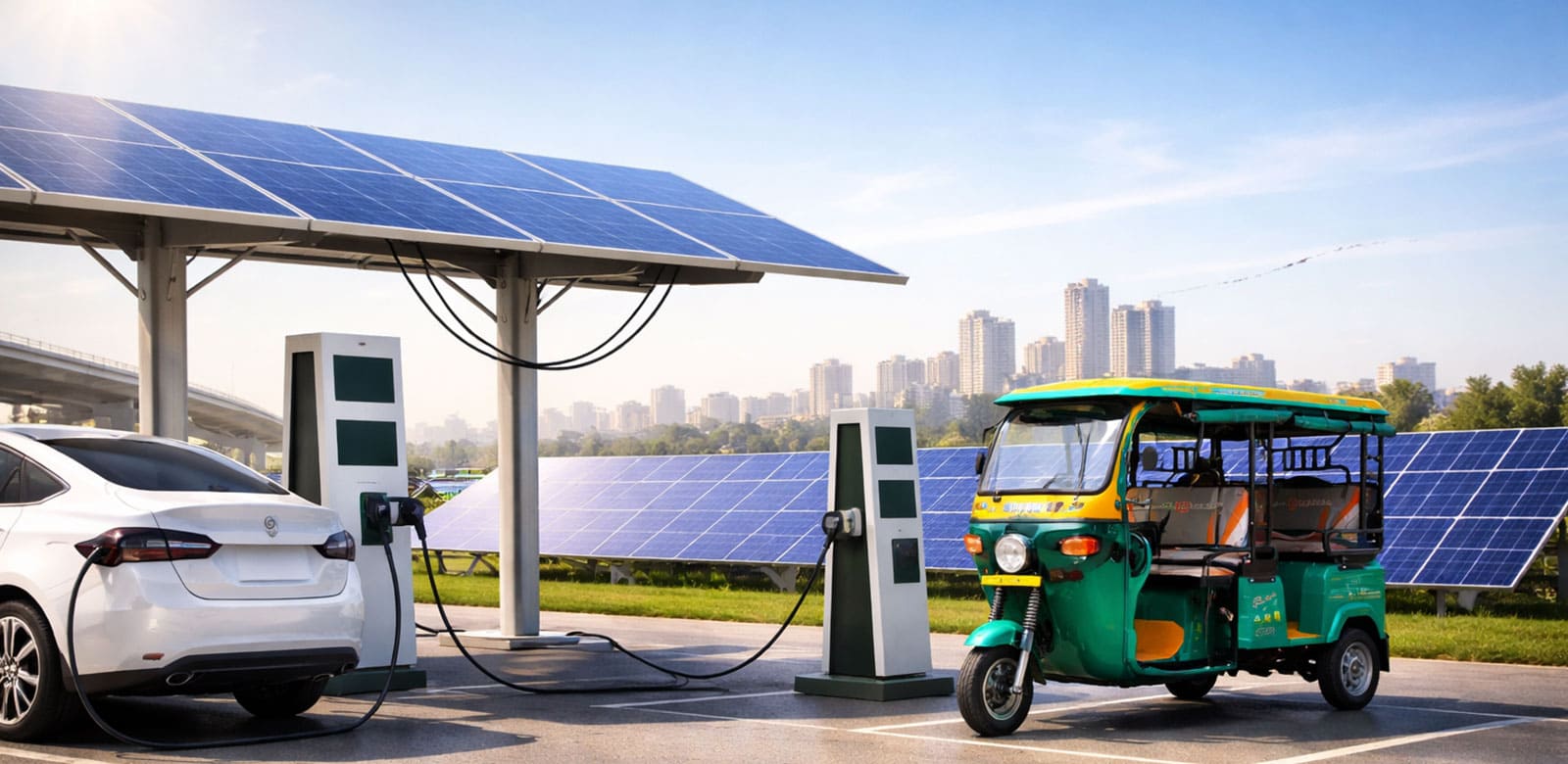
E-rickshaws contribute significantly to daily EV charging demand in India and typically rely on fixed charging locations to charge E-rickshaw batteries such as neighbourhood hubs, depots, and shared yards. This makes charging infrastructure the focal point of energy supply rather than the vehicle itself. Solar generation fits this model because it can be deployed directly at these charging locations, easing pressure on local distribution networks.
For individual operators, access to nearby solar-assisted charging points improves reliability without requiring personal infrastructure investment. For fleet owners managing large numbers of e-rickshaws, centralised depots allow rooftop or canopy-based solar systems to supply multiple chargers efficiently. In both cases, solar reduces daytime grid dependence and stabilises charging costs.
Applications of Solar-Powered EV Charging
Solar-integrated EV charging is already being implemented across various use cases:
- Public charging stations in urban and semi-urban areas
- Highway charging hubs for long-distance travel
- Commercial fleet charging for logistics and delivery services
- Workplace and campus charging facilities
- Residential and apartment-based EV charging setups
These applications highlight that solar-powered charging is beyond just a concept and a practical solution available today.
Conclusion
As electric vehicle charging stations consume more electricity, solar charging becomes essential to reduce dependence on the grid. It helps prevent higher costs, power shortages, and lessen up the pressure on an already overloaded system. When combined with energy storage and smart management systems, solar energy ensures reliable charging even during peak hours or power cuts.
In the long run, EV growth cannot continue without sustainable charging solutions. Integrating solar energy into EV charging infrastructure is not just a smart choice—it is essential for building a reliable, affordable, and future-ready EV ecosystem in India.