
Solar Rooftop Government Schemes
What if your electricity bill dropped to zero—not next year, but starting this month?
Sounds unreal, right? Yet, thanks to India’s aggressively expanding solar panel schemes, that future isn’t just possible—it’s already happening in homes like yours.
In a country blessed with over 300 sunny days a year, the biggest power source is literally shining on our rooftops, untapped. These government-backed programs are not just about saving money—they’re about reclaiming energy independence, cutting pollution,
and transforming everyday households into power producers.
In this blog, we’ll break down how these schemes work, who’s eligible, what kind of subsidies are available, and how you can take advantage of them without getting lost in paperwork.
Why Rooftop Solar Now?
India enjoys over 300 sunny days a year, making it one of the best countries in the world for solar energy. Yet, for many years, solar was seen as expensive, complicated, or only for large-scale industrial use.
That’s changed— dramatically.
Today, with heavy subsidies, easy financing options, and increasing awareness, rooftop solar is more accessible than ever. Government schemes are playing a central role in this transformation, targeting homes, farms, institutions, and tribal areas alike. These programs not only reduce upfront costs but also guarantee long-term savings and energy independence.
Let’s explore the most impact rooftop solar schemes currently active in India.
1.PM Surya Ghar: Muft Bijli Yojana
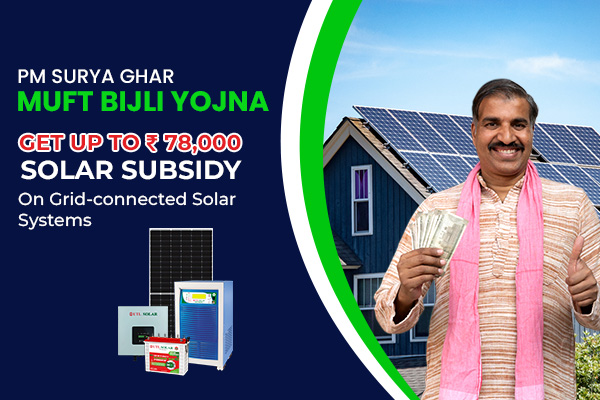
In 2024, the Indian government rolled out a groundbreaking initiative—PM Surya Ghar: Muft Bijli Yojana—designed to make rooftop solar a mainstream solution for everyday households. With an ambitious vision and robust financial backing, this scheme aims to make clean, affordable energy a reality for millions of citizens.
Quick Overview:
- Introduced: 2024
- Target: Deploy rooftop solar systems in 10 million homes nationwide
- Funding Committed: ₹75,021 crore
- Household Benefit: Eligible families can receive up to 300 units of electricity free each month
- Primary Focus: Low- and middle-income groups across India
- Core Advantage: Substantially reduces energy expenses and boosts access to reliable power
By supporting solar adoption at the residential level, the scheme empowers families to cut down on utility bills while contributing to the country’s clean energy transition. Manufacturers and distributors, especially those offering DCR-compliant (Domestic Content Requirement) modules, stand to benefit from this massive demand surge.
2.Grid-Connected Rooftop Solar Programme (Phases I & II)
This ongoing scheme is the backbone of India’s rooftop solar strategy and has evolved over time to better serve residential, institutional, and government sectors.
Phase I (Launched 2015):
- Focused on capital subsidies for grid-connected systems in residential and institutional buildings.
Phase II (Launched 2019, extended to FY26):
- Target: 40,000 MW rooftop solar capacity
- Financial Support: Central Financial Assistance (CFA) up to ₹14,588 crore
- Subsidy: Available for up to 3 kW systems and additional support for systems between 3–10 kW
- DCR Compliance: Requires use of domestically manufactured solar modules
Progress So Far:
- Rooftop solar capacity grew from 1.8 GW in FY2019 to 11.9 GW in FY2024
- Compound Annual Growth Rate (CAGR): 46%
The program empowers residential users by offering upfront subsidies and promotes domestic manufacturing through DCR requirements—boosting Make in India and reducing dependency on imports.
3.PM KUSUM (Kisan Urja Suraksha Evam Utthan (Mahabhiyan)
While not exclusively a rooftop scheme, PM-KUSUM plays a crucial role in decentralizing solar power, especially in rural India.
Objectives:
- Solarize agricultural pumps and promote solar-powered irrigation
- Install 10 GW of decentralized ground-mounted solar power plants
- Deploy 2 million standalone solar pumps
- Convert 1.5 million grid-connected pumps to solar
Progress as of Jan 2024
- 165.28 MW of solar power plants installed
- 295,823 standalone solar pumps deployed
- 7,384 grid-connected pumps solarized
This program reduces farmers’ reliance on grid electricity and diesel, lowers input costs, and supports sustainable agriculture. It’s also a key livelihood enhancer for rural communities.
4.PM JANMAN (Pradhan Mantri Janjati Adivasi Nyaya Maha Abhiyan)
Focused on India’s particularly vulnerable tribal groups (PVTGs), PM JANMAN ensures electrification through solar in some of the country’s most remote regions.
Scope:
- Electrification of 1 lakh households in tribal areas
- Coverage: 18 states and the Andaman & Nicobar Islands
- Uses solar rooftops and microgrids for energy access
This initiative is a powerful example of how solar can bridge the energy access gap in geographically and economically challenged regions.
5.National Solar Mission (Jawaharlal Nehru National Solar Mission – JNNSM)
A flagship policy under India’s climate action strategy, JNNSM lays the foundation for the country’s long-term solar ambitions.
Focus Areas:
- Promote sustainable growth and energy security
- Enable large-scale adoption of solar power across sectors
- Supportive policies like:
This initiative is a powerful example of how solar can bridge the energy access gap in geographically and economically challenged region
✅Solar Park Scheme
✅CPSU Scheme
✅ ISTC Waivers
✅Renewable Energy Certificates (REC)
✅Renewable Purchase Obligations (RPO)
Under this mission, India has committed to achieving 280 GW of solar capacity by 2030, with rooftop solar expected to play a crucial role.
6.International Solar Alliance (ISA)
Vision:
Though not a domestic scheme per se, the ISA is a strategic global effort led by India to promote solar energy adoption worldwide.
- Create a global market for solar
- Facilitate joint R&D, innovation, and policy frameworks
- Promote cross-border solar investments
This initiative strengthens India’s role as a global clean energy leader, while opening up opportunities for domestic businesses and innovators in the solar supply chain.
Key Benefits of Solar Rooftop Schemes in India
These government schemes aren’t just beneficial for policy or the environment—they bring tangible advantages to individuals and communities:
For Homemaker:
- Government subsidies reduce upfront Investment
- Massive savings on monthly electricity bills
- Energy independence and protection from tariff hikes
- Increased property value
For Farmers:
- Low-cost irrigation through solar-powered pumps
- Reduced diesel dependency
- Better income stability
For Businesses & Institutions:
- Meet corporate sustainability goals
- Reduced operational costs
- Tax incentives (like accelerated depreciation)
How Indian Solar Brands Are Capitalizing
Domestic solar companies, especially those with wide distribution networks and DCR-compliant products, are uniquely positioned to benefit from this policy ecosystem.
For instance, solar brands with:
✅ Pan-India dealer presence
✅ Affordably priced rooftop kits
✅ End-to-end support for installation & subsidy application
can serve as the bridge between policy and public adoption. The convergence of government support + manufacturing capability + last-mile delivery is what will make the rooftop solar revolution truly inclusive.
Challenges & the Road Ahead:
Despite the progress, some challenges persist:
✅ Awareness gaps in rural areas
✅ Lengthy subsidy disbursal processes
✅ Grid integration issues in some states
✅ Need for quality assurance and skilled manpower
However, with ongoing improvements in digital application portals, financing options, and central-state coordination, these are being addressed steadily
Conclusion: The Future Is on Your Rooftop
India’s solar rooftop journey is more than just an energy transition—it’s an economic, environmental, and social revolution. Government schemes like PM Surya Ghar, Grid-Connected Rooftop Programme, PM-KUSUM, and PM JANMAN are making it easier than ever for individuals and communities to take part in this movement.
Whether you’re a homeowner looking to cut your electricity bill, a farmer seeking reliable irrigation, or a business aiming for sustainability, the opportunity is real—and it’s right above your head.


3 kv
3kv
Formhouse rooftop solar system at sankarpally telagana state,prasant electricity bill rs 3000/- – 4000/- per month ,required address naiky formhouse, Yellakonda village, mehatabkhan guda ,navabpet Mandal,Vikarabad dist ,telagana, cell no 86889 34750, mail address ratnakarb1955@ gmail com
Formhouse rooftop solar system at sankarpally telagana
मे डीलरशिप से काम करना हे
मे डीलरशिप से काम करना हे ओर यहा का आस पासके ऐरीया मे काम चल रहा हे
Just one single bedroom house and one water pump so how much we have to pay
I want to get solar rooftop and I am 74 years old pensioner. Please help me by visiting home and do the needful., as it is PMs scheme.
Thanking you.
9945945355
Belagavi 590019
Karnatak.